
Feature
Instrumental
- heather anne lee
- Fred Lopez
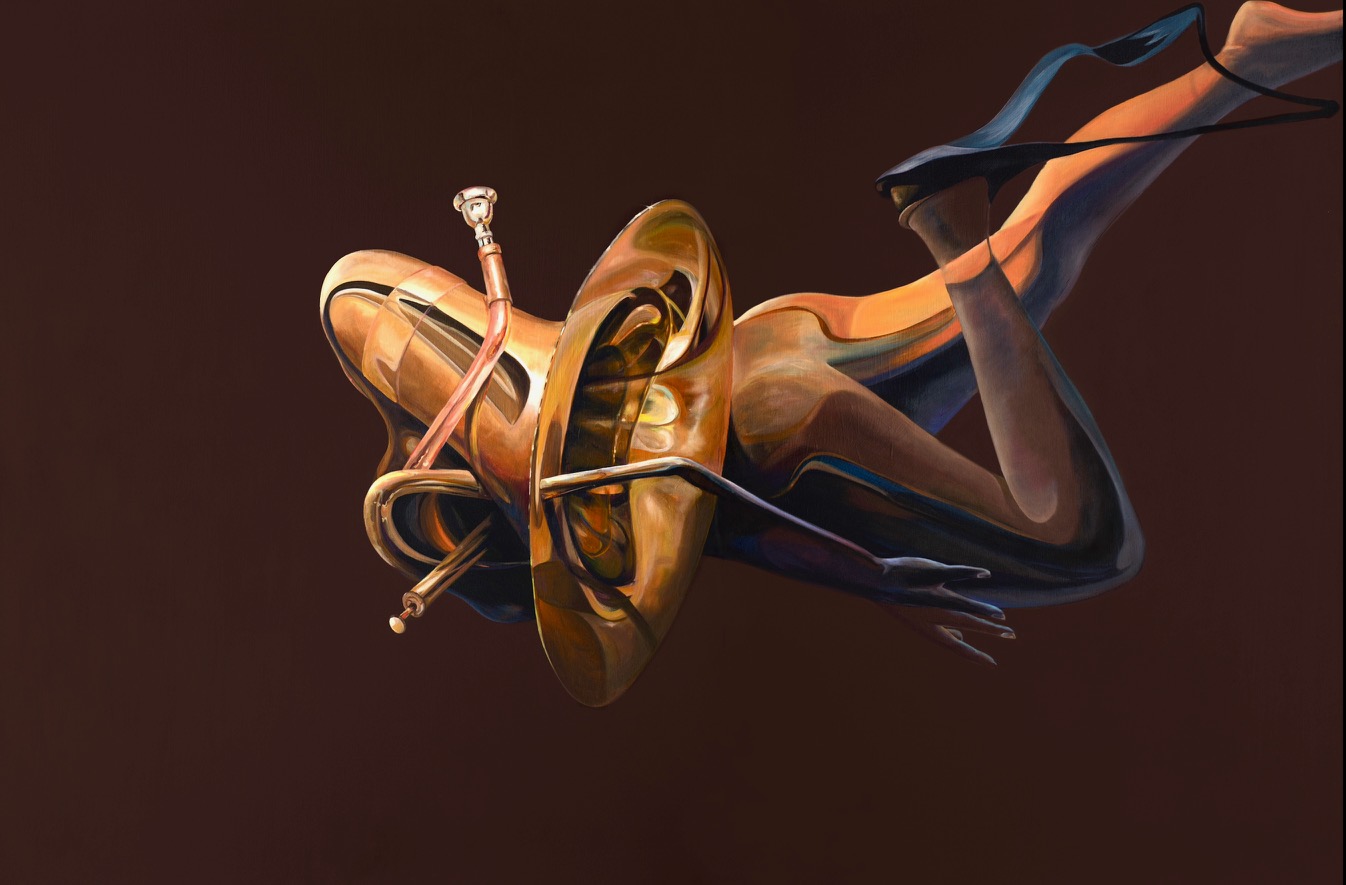
The first time I saw First Dive, I felt myself go underwater.
Not the sparkling blue water of vacation photos, but the deep, muffled place beneath it, where the world recedes and the sounds inside your own body grow louder. A heartbeat. A held breath. The strange rush of imagination when there is nothing left to hear but yourself.
At the center of the canvas, a woman seems to float through warm brown darkness. Her body bends and gleams, skin slipping into brass, legs extending from the coiled tubing of a tuba. There is movement without any obvious destination, the sensation of being suspended somewhere between sinking and rising. The longer I looked, the less certain I became of what I was seeing. I only knew how it made me feel.
By the time I learned what the painting meant to Andy Beauchamp, it was already coming home with me.
Andy began First Dive with memories of teaching his daughter how to swim. He had closed his eyes underwater and noticed that the color behind them was not blue at all, but a murky brown. Why, he wondered, should he paint water the way everyone expects water to look instead of the way he had experienced it?
What Andy placed inside the painting and what I found there were not quite the same.
And that delights him.
“If you notice something in my pieces that I didn’t notice, that’s even better for me,” he says. “I’m not here to tell you the answer. I want you to figure it out yourself.”
The same invitation follows him into his Honors Art classroom at Windermere Preparatory School.
On this particular morning, The Temptations are singing “My Girl.” Ray Charles will eventually tell everyone to hit the road. Bobby McFerrin will remind them not to worry, be happy. Tomorrow could bring Mozart or classic rock. No one in the room tries to guess what’s next anymore, and that’s part of the fun.
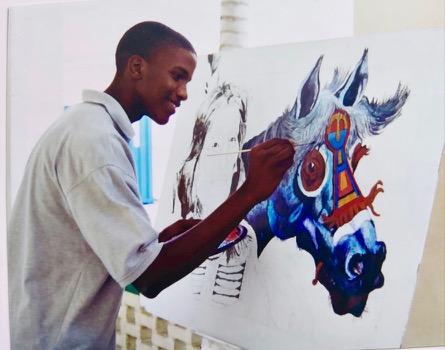
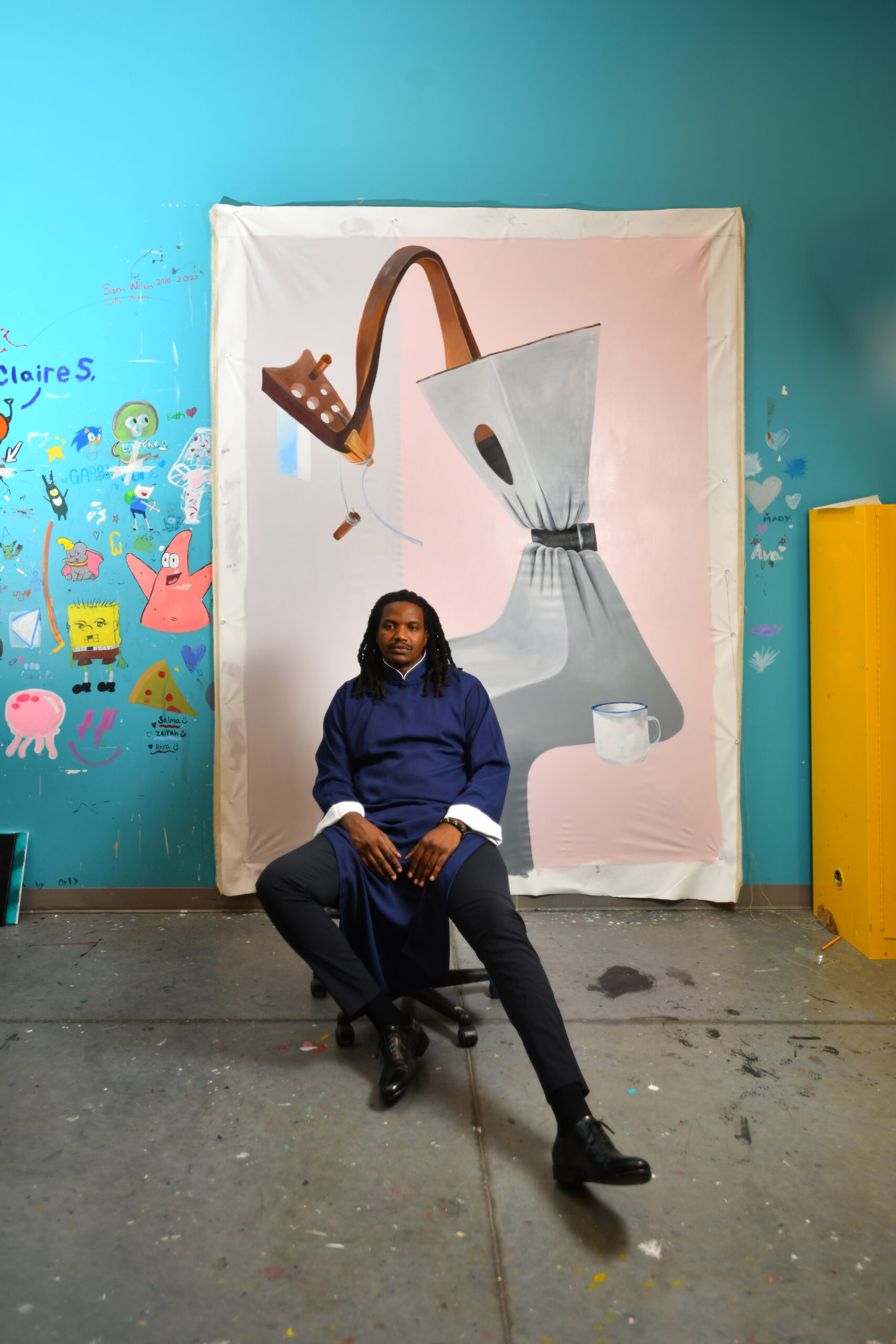
There is color everywhere in Andy’s room, but the left wall is impossible to miss. Painted turquoise, it is covered with signatures, sayings, and small pieces of art left by graduating seniors, a kind of evolving yearbook written directly onto the classroom itself. Beneath it, students work on portraits while Andy moves among the emerging faces in his usual uniform, apron on, bandana tied around his hair.
He is teaching, but he is also painting, and that matters.
“They need to see that I’m doing the work, too,” he says. “If I’m not painting, they don’t bring the same energy.”
So he paints. They paint. The music keeps changing. In the middle of that controlled chaos, Andy is teaching something much harder than how to draw a face.
Outside the Lines
His biggest challenge, he says again and again, is getting students to see outside the boundaries.
Not simply the boundaries of art, although those certainly count. Andy wants them to challenge the way they perceive themselves, each other, and the world around them. A portrait, after all, can teach you where an eye belongs in relation to a nose. It can also force you to consider whether getting the face exactly right is really the point.
It took Andy a while to understand the difference.
When he began teaching 16 years ago, he was young, accomplished, and, by his own admission, a little too interested in getting students to do things the right way. He knew what good work looked like. He knew what they were capable of becoming. The problem, as anyone who has ever attempted to lovingly improve another human being eventually discovers, was that Andy’s definition of their potential looked an awful lot like Andy.
“I felt like the first few years I pushed the kids a little bit too hard,” he says. “I had to step back.”
The lesson arrived one line at a time. Andy noticed a student’s perspective was wrong, erased her line, and redrew it where it belonged. Technically, he had corrected the problem.
Then she began to cry.
“She said, ‘I thought I had it right. Now I feel stupid,’” Andy remembers. “And that hurt me. I had to walk outside.” He pauses. “That moment changed me… as a teacher and as an artist.”
He had seen the errant line clearly, but he had not seen the person who drew it.
After that, Andy began putting the student before the lesson. “I learned that you have to lead with love,” he says. “With everything.”
Today, Andy says a class of 18 students is really 18 different classes. Each student sees differently and needs something different from him. Put the same green apple in front of them and no two will mix quite the same green.
“They each have their own song, you just have to help them find it,” he says.
Technique still comes first. Younger students learn proportion, perspective, and the architecture of a face. Andy wants them to look carefully enough to paint the apple in front of them. But by the time they reach his honors class, he begins asking them to dismantle some of what he taught. “When you break it, that’s when I know the learning happened,” he says.
The goal was never to create 18 versions of Andy Beauchamp. He wants students to gather something from every artist and teacher they encounter, then combine those pieces into a language of their own. “You pick from everybody to create your own bowl,” he tells them. “I don’t want you to paint like me. I want to see your perspective.”
Beyond the Frame
Perspective fills Andy’s canvases, where water need not be blue, an instrument becomes a body, and an overlooked woman becomes a warrior.
Six years ago, those canvases looked different. Andy was known for realistic portraits and scenes of Haitian life. He had experimented with surrealism in high school, but it wasn’t until 2020, amid the pandemic and the national reckoning following George Floyd’s murder, that his art began to change. Realism no longer seemed enough to express what he was feeling. Bodies and instruments began slipping into one another, creating a visual language rooted in influences that went back decades.
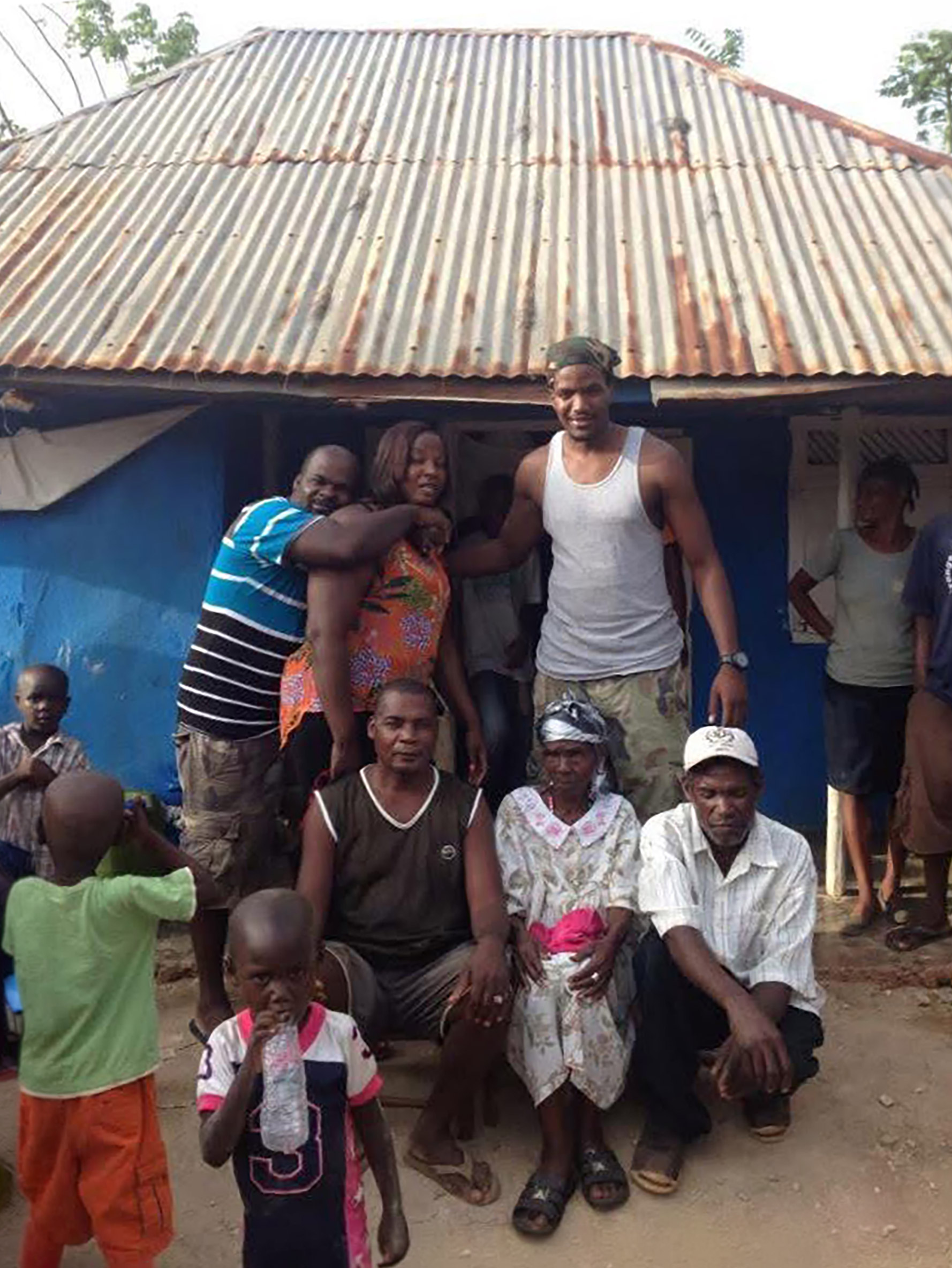
Born in the Bahamas and raised in the Haitian countryside, Andy grew up without television. His family listened to the radio, and he imagined the faces behind the voices. His mother danced. His brothers played acoustic guitar, well suited to a place where electricity could not be assumed. At night, elders told stories that changed as they spoke, truth and invention sharing the same breath.
Years later, Andy found a way to paint like that.
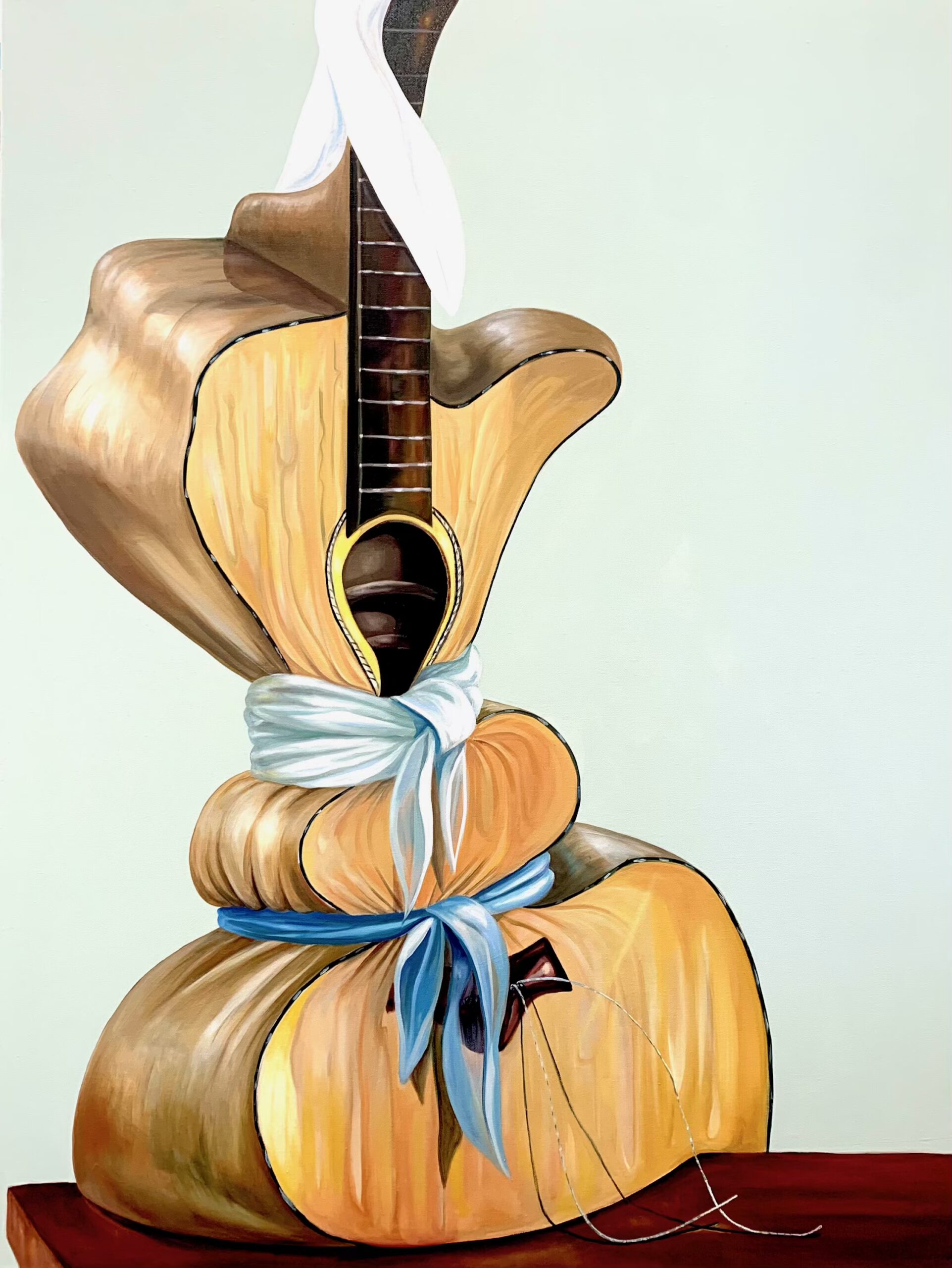
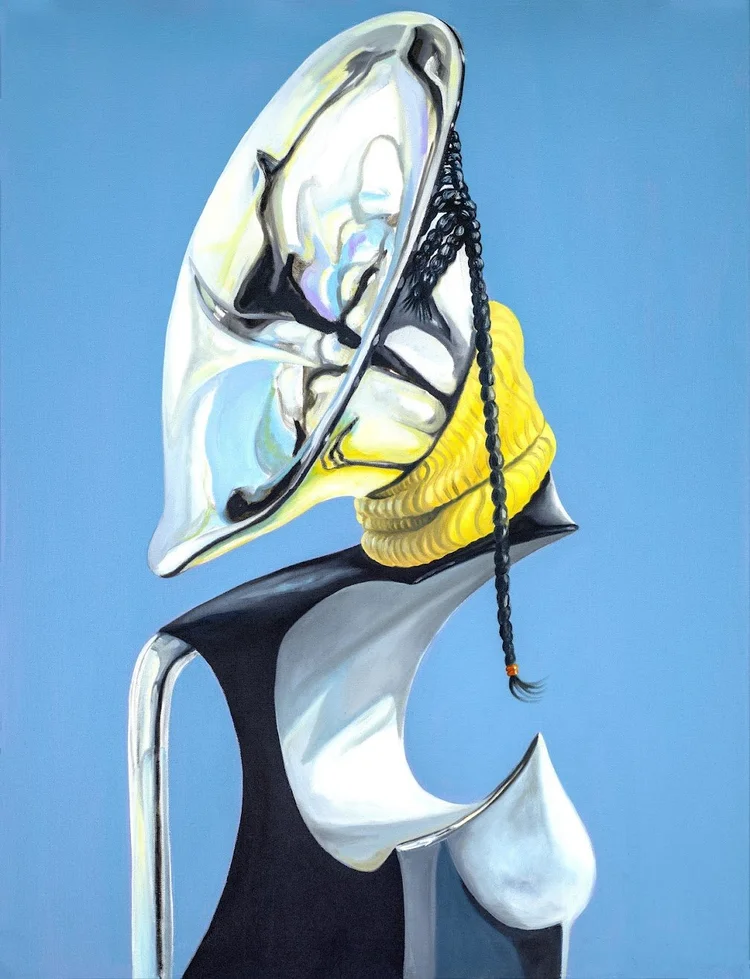
In Turtleneck, a woman’s face becomes the pearly bell of an instrument while a black cord hangs like a braid. In Confident, glossy strokes of red, turquoise, and gold make figure and horn occupy the same skin. The rigid machinery of music becomes fluid, sensual, and alive. In Tribulation, an acoustic guitar rises from a woman’s body, bound tightly around the middle. The fabric recalls Andy’s grandmother, who tied her stomach while mourning her children, and those who bind their stomachs against hunger. The figure is beautiful and suffocating at once.
His newest painting, Ti Haiti, carries a different kind of grief.
The inspiration came from Pierre Damas Bel, a 20-year-old Haitian student in Springfield, Ohio, who died by suicide in August after being fitted with an electronic ankle monitor by immigration authorities. Bel, a high achieving honor student and athlete, had an asylum claim pending, but changes to immigration protections for Haitians had left his future uncertain. His family said the monitor left him feeling humiliated, as though he were being treated like a criminal. In Haitian culture, Andy explains, that label carries a particularly profound stigma.
The story stayed with him. And Andy began painting.
Against a background of soft pink and blue, reminiscent of Haitian homes in Miami, a woman’s body emerges from the shape of an oil can. In Haiti, where electricity is unreliable, empty cans are often repurposed into homemade guitars or banjos, strung with fishing line of varying thicknesses to create different notes.
But it’s the woman’s waist that tells Pierre’s story.
An ankle monitor cinches her body where the instrument narrows, turning a device of surveillance into a symbol of humiliation and confinement. A small window suggests another kind of longing. For home, perhaps. Or simply for the freedom to step outside without fear of being questioned, detained. or taken away.
Like Tribulation, the figure is beautiful and suffocating at once. What first appears whimsical becomes something far more unsettling.
“Every painting, there’s a story. A memory,” Andy says. He pays attention to what he sees, but he does not always know when or how it will reappear. Something he notices today may go directly onto a canvas. A person, place, or experience from years ago may surface much later, sometimes only after he has begun painting. “Little whispers,” he calls them.
Back in the classroom, Andy pays the same attention to what his students carry, even when it has nothing to do with art. At the beginning of the year, he stands on a table and tells students to leave the day’s drama outside. If someone has had a hard night, he lets them rest. The painting can wait.
“Every painting, there’s a story. A memory,” Andy says. He pays attention to what he sees, but he does not always know when or how it will reappear.
The Ones Who Saw Him
Long before Andy learned to make room for another person’s possibilities, several people made room for his.
He was the second youngest of 17 children, with only a baby sister behind him. When both parents died in the same year, 12-year-old Andy was left with grief he was too young to carry. His older sisters stepped in to help raise him.
Andy became a man at 12. But “art has always been my escape moment,” he says.
After he came to the United States as a teenager, his 6-foot-8 frame made basketball the first thing people noticed. The sketchbook was easier to miss.
When Andy entered Eric Jenkins’ ninth-grade art room, Mr. Jenkins took one look at the athlete and asked whether he was certain he belonged there.
“We’ll find out,” Andy answered.
By year’s end, Andy had joined the advanced students. Mr. Jenkins became the first person to buy his work, a colored-pencil drawing made before Andy seriously used paint. “He believed in me since day one,” Andy says.
That belief outlasted high school. Andy spent three years waiting for immigration documents that would allow him to attend college. He played basketball in Miami parks and worked under the table at Fish Bait Masters, where customers took one look at his height and youth and asked what he was doing there.
They could not see him sketching during lunch breaks or doing push-ups in the freezer, readying himself for an opportunity that had not arrived.
“People ask you why,” Andy says, “but they don’t know your story.”
Eric Jenkins knew enough of Andy’s story to keep opening the art-room door. He called him for mural jobs and gave him somewhere to create when paint was too expensive. It was a teacher who kept making room — smaller and quieter than a rescue, but it lasted.
Basketball eventually carried Andy to college, where teammates nicknamed him “Paintbrush” because he left practice and went to paint. Teaching, however, “was never my thing.” Then he met Brad Ramsey in a gym.
Brad asked what he did.
“I like to paint,” Andy told him.
“You like to do what?”
“I’m an artist.”
“Show me some work.”
It is difficult to know, while we are living them, which ordinary conversations will divide a life into before and after. This one did.
Brad was an artist himself, one Andy still describes as among the best he has ever known. He helped bring Andy into Windermere Prep, where the two became colleagues and then best friends. Together, Andy says, they “took over the school,” filling spaces with art, including Brad’s classroom ceiling tiles. Outside of school, they fished. They traveled to Key West, where Brad had grown up, and shared a love of the water that still finds its way into Andy’s work.
Three years later, Brad died.
Afterward, Andy painted a tarpon across a jacket, carrying something of their friendship into the image. Then the jacket disappeared among his belongings. Years later, he found it again, just as fish had begun swimming back into his work, their bodies now merging with the instruments and human forms that populate his canvases.
“Brad showed me how to appreciate working with students,” Andy says.
And Andy’s still there, at Windermere Prep, playing music, painting beside his students, and learning when to correct the line and when to let it find its own way.
The View From Here
For all the care Andy gives to teaching technique, he is surprisingly unconcerned with whether his students become artists. “I’m not asking you to be an artist,” he tells them. “Every person you face, try to give them the respect that they deserve.”
He hopes that respect follows them beyond the classroom, especially when they do not know someone’s full story. If art can teach students to question their first interpretation of a line, a color, or a face, perhaps it can also make them slower to judge another person.
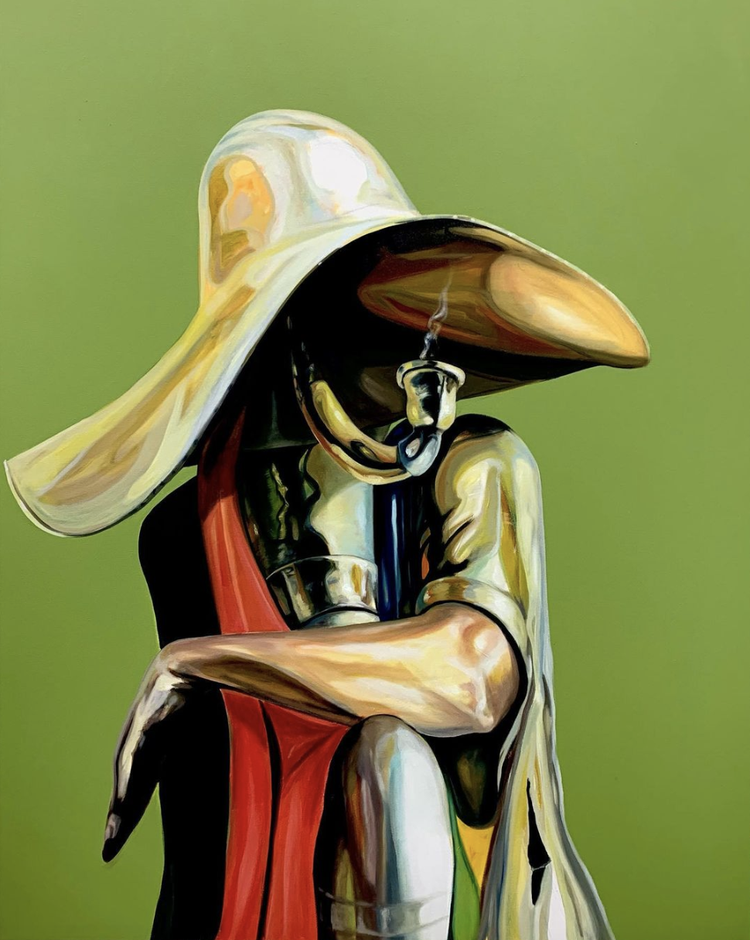
In Faceless, that lesson takes human form. Against a field of green, a Haitian street vendor peers from beneath an enormous, weathered hat, her face swallowed by its shadow. A pipe rests between her lips, its long curve resembling the mouthpiece of a brass instrument. Even here, music finds its way into the composition.
To the customers who approach her, the woman may be little more than the hands that pass them what they came to buy.
“You don’t really see their faces,” Andy says. “All you want to do is get your goods and walk away. But at home, that woman is a hero. She’s a warrior. She feeds her family.”
Faceless is how the world encounters her. Warrior is who she has been all along.
That distinction matters to an artist who knows how quickly appearances harden into assumptions. A roadside painting is valued differently in a gallery. A teenager behind a bait counter becomes whatever strangers presume. A student who draws the wrong line believes she is bad at art.
“As a society, we’re too quick to decide who someone is,” Andy says.
His antidote is curiosity, the willingness to look beyond the first impression and remain open to what it cannot tell us. “Learning about that person will change your perspective,” he says.
He cultivates the same curiosity at home. His daughters, 10 and 6, abandon their screens at the word paint. Andy draws them into the kitchen, garden, and fishing boat, teaching them to cut an onion, dig for sweet potatoes, and notice how things are made. It’s the same thing he wants from his students.
Meanwhile, Andy’s own hunger to create keeps growing. He paints every day, applies for larger shows, and dreams of a studio with room to work without holding back. He wants the world to see what he can do. Sixteen years of teaching hasn’t gotten in the way. If anything, the whispers have only gotten louder.