

Feature
The best bicycles in the area are built in a garage thanks to Chris Holzner’s passion for riding and his engineering expertise.
- heather anne lee
- Fred Lopez
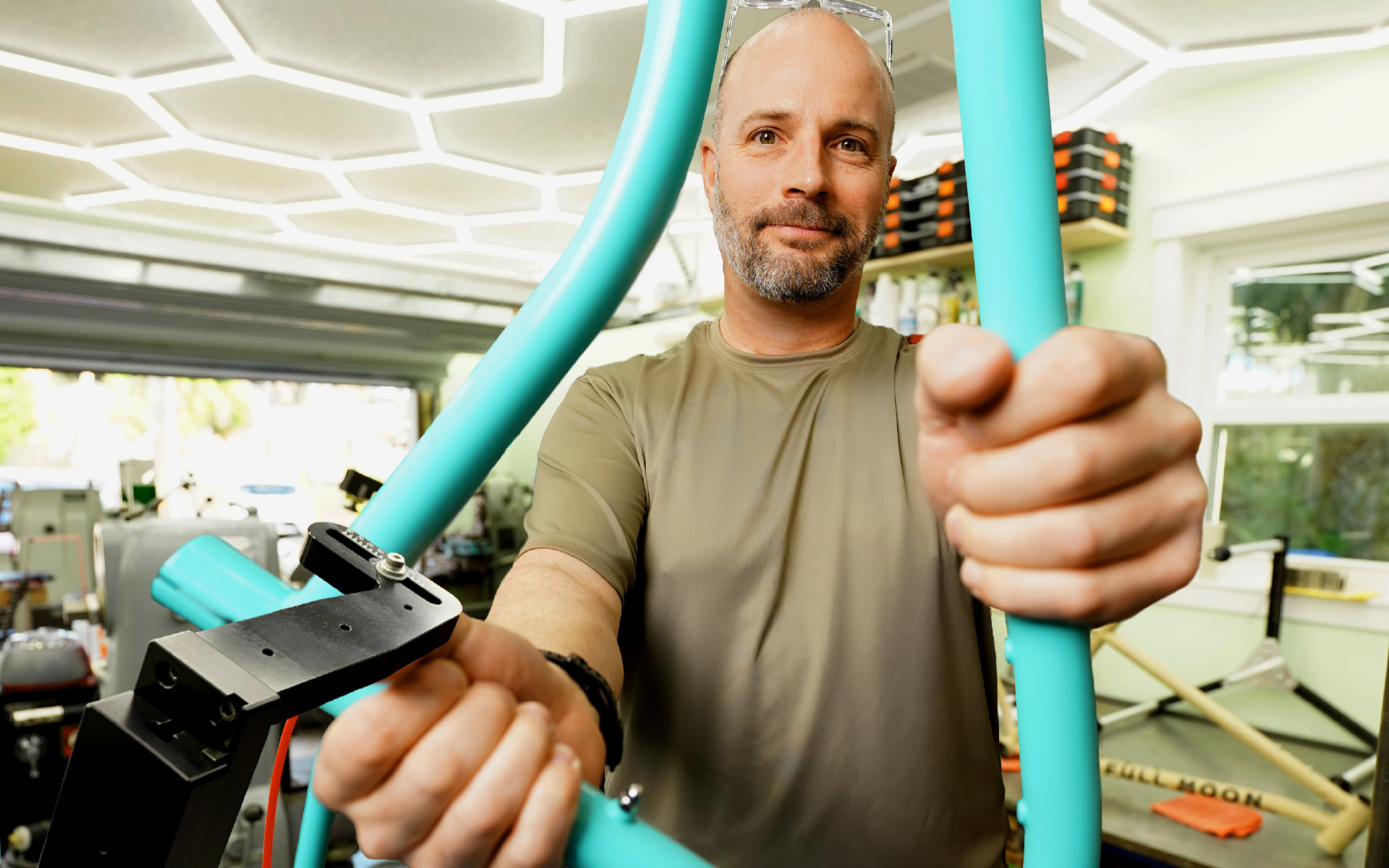
Every great project begins with optimism and a mild underestimation of consequences.
Sometimes that means moving across the country. Sometimes it means gutting a 1968 house down to the studs. And sometimes, if you happen to be dating a retired Army engineer with a lifelong obsession with bicycles, it means saying, “Yes, of course we can wire the garage for industrial machinery. We’ve been together four months. This seems sensible.”
This is how a quiet Winter Garden home acquired something most suburban garages lack: a legitimate machine shop parked beside a Jeep that, by treaty, still gets the prime spot.
Chris Holzner has been riding bikes since he was small enough to believe speed was mostly about bravery. Unlike most kids, he didn’t just ride fast — he took things apart to figure out why they were fast. BMX became road cycling, paused for Army service, then returned as mountain biking in college. Somewhere along the way, a thought settled in his mind and refused to leave:
Riding bikes was fun.
Building them would be better.
Not showroom bikes. Not carbon-fiber status symbols. Proper machines. The sort that start as plain metal tubes and end as something that feels less like equipment and more like a mechanical extension of the rider’s nervous system.
The GI Bill sent him to frame-building school in Oregon, where he learned the useful and slightly obsessive art of cutting, mitering, welding, filing, and measuring metal to tolerances most people reserve for spacecraft components. This is how “I like bikes” becomes “that tube needs to be 0.3 millimeters thinner, and I will now explain why.”
The shop came later. First came the truly high-risk operation: a relationship.
Renovation, Relocation, and Relationship Speed-Runs
Chris and Michelle Buczkowski met the way endurance athletes often do: through triathlons, mutual suffering, and early mornings that make normal humans question their life choices. Years later, after life had shuffled the pieces around, Chris wasn’t just looking for a place to live. He was looking for a place to land. A fresh start.
Michelle already had a house in Winter Garden mid-renovation. Walls down. Ceilings open. Electrical systems exposed. It was chaos of the hopeful, dusty kind.
Chris, retired from the military and armed with a construction management background, did what any man hoping to impress a strong, capable woman might do: he moved in and ran the renovation. While living at her parents’ house. Together. After dating a mere four months.
“It won’t be long,” the contractors promised. “Three weeks, at best.”
Five months later, everyone knew each other’s coffee orders, thermostat preferences, and exactly how many towels constituted “too many” in a shared bathroom. Miraculously, no family imploded. Instead, there was a fast-tracked blending of lives and a level of trust most people pay decades to reach.
Somewhere between rewiring walls and reframing ceilings, Chris asked a question that could have ended everything: “Hey, while the electrical’s open, can we put in the infrastructure for a shop? Just in case?”
This is where many love stories would crash into a ditch. But Michelle didn’t flinch. She said yes. Not to a pegboard. Not to a hobby shelf. To the full electrical backbone required for a precision fabrication shop in her garage.
One rule remained: her Jeep still parks inside. Love is generous, supportive, and patient, but it does not scrape love bugs off the windshield at 4 a.m.
Engineering the Dream Garage
Before the first spark flew, there was wiring. Glorious, excessive wiring. 50-amp service, dedicated circuits, insulation, climate control, walls sturdy enough to make a commercial contractor nod in quiet approval. Chris does not do “good enough.” He does “this could probably survive atmospheric reentry.”
The result doesn’t feel like a garage. It feels like a small American machine shop from a time when things were built from cast iron and stubbornness.
Along one wall sit two vintage Hardinge horizontal milling machines from the 1940s and ’50s. Cast-iron, Navy-stamped, and heavy enough to make a foundation designer sweat. They weren’t designed for bicycles. They were designed for serious metal. Machines Jeremy Clarkson would pat and call “proper.”
Modern CNC machines are brilliant. Fast, precise, tireless. But these Hardinges offer something rarer: feel. You sense the cut through the handwheel. Hear when the tool is happy. Notice when the metal disagrees. Less “press start,” more mechanical conversation. Like driving something old, loud, and honest enough to punish stupidity.
Each tube is cut and shaped here. Angles dialed by hand. Fit checked by eye. Metal meets metal cleanly, not because a computer said so, but because a human noticed. In a world of automation, this is gloriously analog. And in this shop, that is the point.
Frames move to a custom welding fixture, rotated like sculptures as Chris lays beads with calm focus. Some joints are welded — metal fused into one. Others are brazed with molten silver, bonding without melting. Engineering. Art. Fire. Patience.
On the wall hangs an old shop clock from his grandfather, a sheet metal worker. Different trade. Same lineage. Same belief: working with your hands is a perfectly good way to build a life.
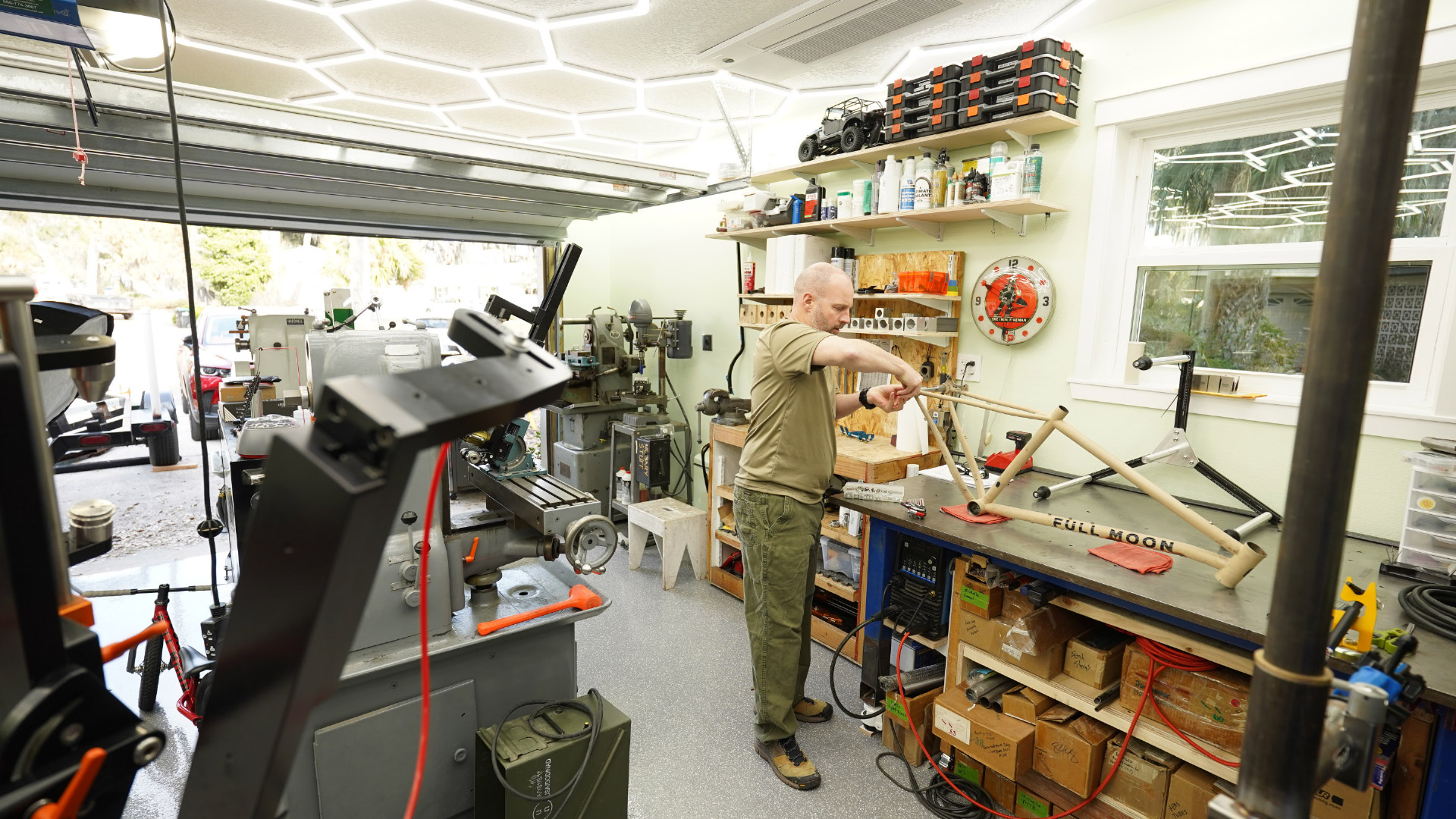
Each tube is cut and shaped here. Angles dialed by hand. Fit checked by eye. Metal meets metal cleanly, not because a computer said so, but because a human noticed. In a world of automation, this is gloriously analog. And in this shop, that is the point.
Full Moon Ahead
Every bike starts with a person. Height. Weight. Riding style. Goals. Strength. Comfort. History. Chris chooses tubing like a tailor picks fabric, except this suit may spend weekends rattling down dirt roads at questionable speeds.
One bike is child-sized, built for his granddaughter with the care most companies reserve for race machines. Hubs from California. Rims from Michigan. Headset from Oregon. Chris knows the people behind the parts. Walked their factory floors. Sourced American-made whenever possible. Not patriotism. Relationships. Craft supporting craft.
Another bike belongs to Michelle, the woman who agreed to industrial wiring on month four and also happens to complete endurance events that make normal athletes nap for a week. Her next bike is built for long gravel miles and multi-day trips where the road turns quiet and the phone stops mattering.
The name on the wall, Full Moon, comes from nights Chris spent deployed in Afghanistan, high in a mountain valley with no artificial light. Under a full moon, the landscape glowed like daylight. Ridges, shadows, distance, everything visible. That memory stuck, not as a war story, but as a clarity story.
Full Moon bikes carry that clarity forward. Built for adventure, performance, or both, each frame can be tailored to your ride, from podium-ready to off-the-grid explorations. Tiny mounting points, or “zits,” Chris jokes, hide bags and gear beneath you on long dirt roads and forest trails. Carry what you need. Go somewhere quiet enough to hear yourself again. Just like those moonlit mountains.
Chris once imagined frame building as a full-time career. Life rerouted the map: family needs, cross-country moves, pandemic supply shortages, a marriage ending, stay-at-home grandfather duties for a daughter and son-in-law currently serving. He adjusted, not abandoned.
Now the shop hums steadily, part-time. One frame at a time. One rider at a time. Built not for mass production, but for meaning.
In a renovated garage behind a Florida house that began with a leap of faith, sparks still fly — both from the welding torch and from ambition, shaping steel for the long ride ahead.
The name of the frame, Full Moon, comes from nights Chris spent deployed in Afghanistan, high in a mountain valley with a no artificial light.
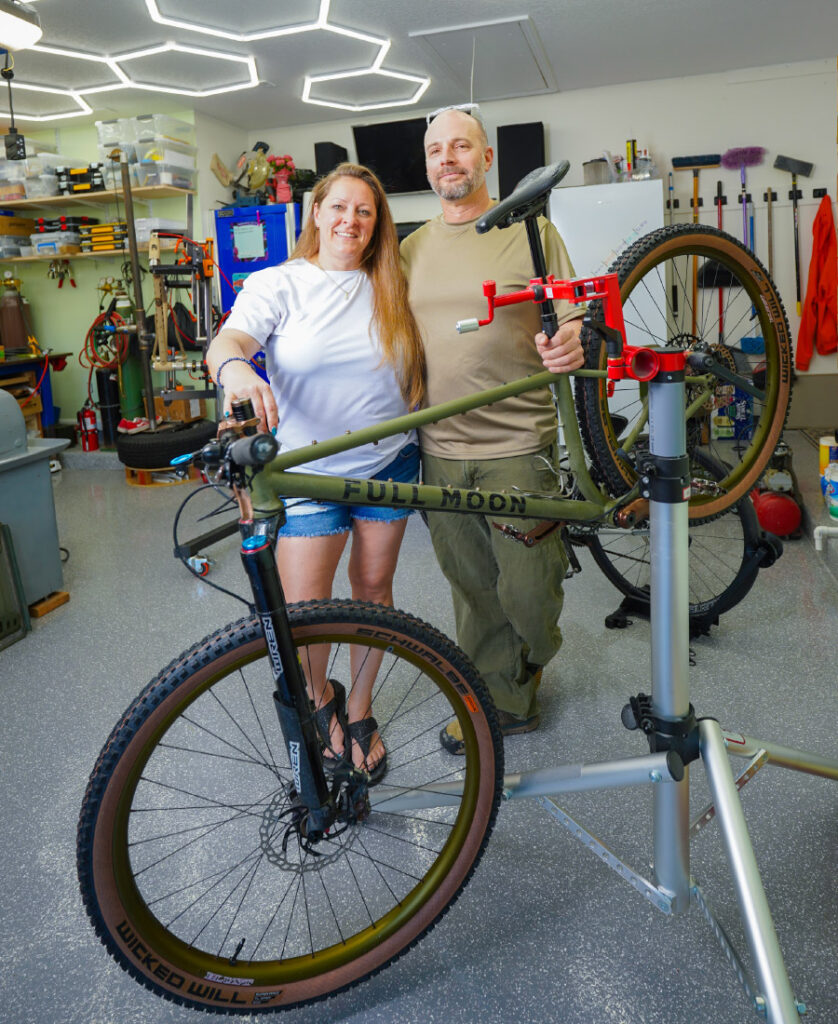
For Michelle Buczkowsk and Chris Holzner, their relationship came with a frame and a future.