


Feature

Polarizing to some, steadfast to others, Austin Arthur’s run
for office became a meditation on modern politics,
marriage, and the price of service.
- heather anne lee
- Fred Lopez
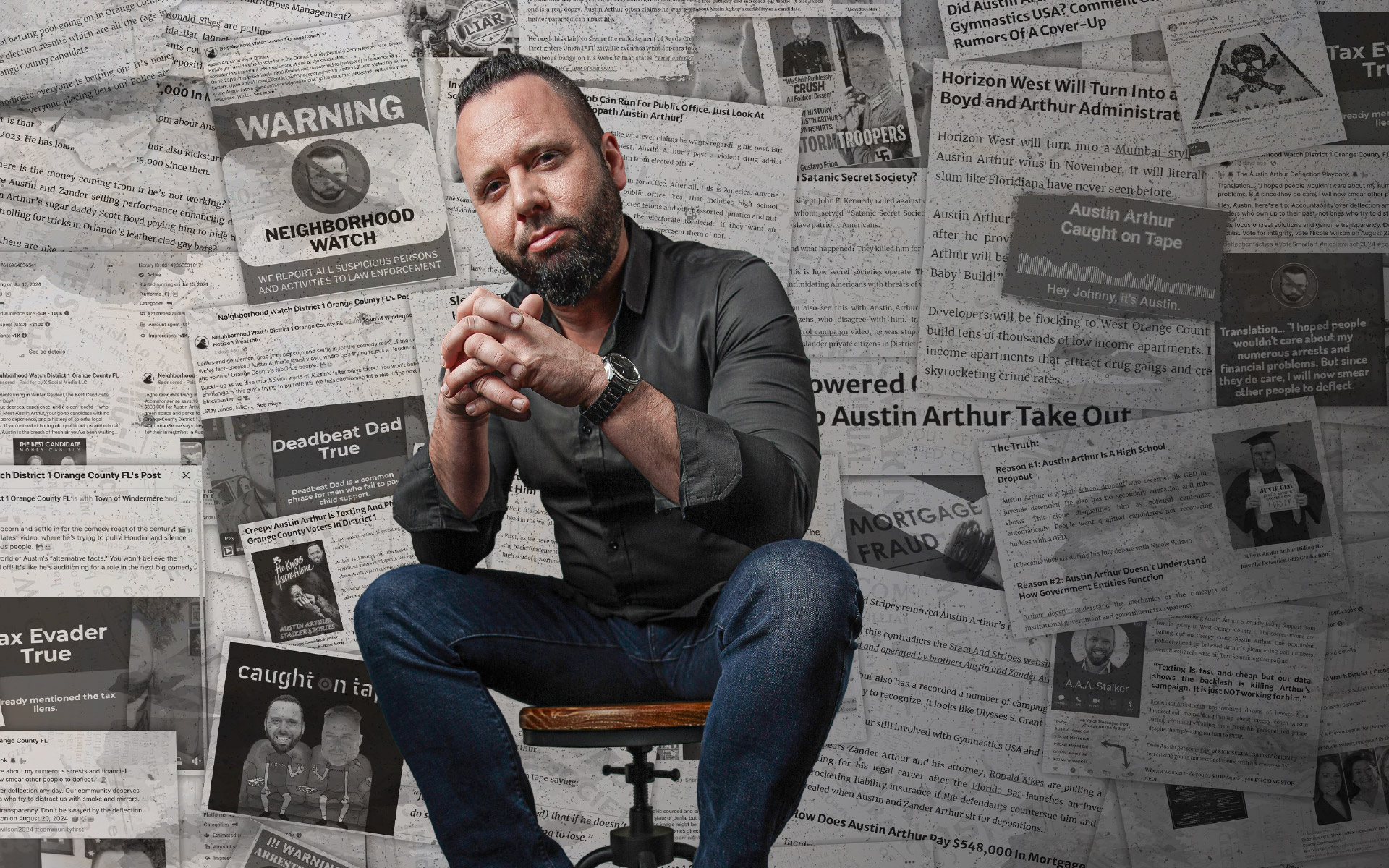
He does not look like a villain.
That feels important to say at the beginning, because in some corners of West Orange County, the name Austin Arthur lands like a slammed door. In others, it rises like a hymn. There are yard signs still tucked behind garage shelves, and there are people who would rather swallow nails than say his name out loud. I have met both.
When we sit across from each other in The Churchill Room, his second favorite place in the world, he tells me, the first being home with his family, there is a bottle of wine between us and no podium in sight. The private office walls carry historical artifacts, old photographs, heirlooms that suggest legacy matters here. The lighting is low and forgiving. The kind of room where voices drop and truths, if they are going to come, come quietly.
He is not storming. He is not performing. There is no crowd to win.
He turns the stem of his glass slowly, the way people do when they are replaying something heavy in their minds. Campaign weather is strange that way. It begins as a small cloud of civic responsibility, a few conversations, a nudge from your wife, a sense that maybe you could help, and then almost without warning, you are standing in a sideways hailstorm of opinions, half-truths, and Facebook prophets who have never met you but are certain they know your soul.
In this room, though, there is no hail. Just a man who once thought service would be enough, now talking about what it cost to find out it wasn’t.
Before the Yard Signs
It was the spring of 2022, and Austin was still, technically, a private citizen. A business owner. A dad who measured his life in school drop-offs and late-night emails. A guy whose world felt full but contained—family, work, community boards, the steady rhythm of a life that made sense.
He wasn’t running for anything. But he was paying attention.
West Orange County was growing faster than its infrastructure. Traffic was tightening like a vise. Schools were filling. Decisions were being made downtown that didn’t always seem to include the people actually living with the consequences. Austin had been in the rooms. He’d seen how things worked. And more importantly, how they didn’t.
He began having quiet conversations.
Some were with community leaders. Some with people already serving. Others with residents who cared deeply and had the credibility to run. If someone else was prepared to step forward— someone steady, thoughtful, ready for the weight of it—he was willing to support them. He wasn’t looking for a political showdown. He was looking for the right person.
What began as an outward search slowly turned inward. At some point, the conversation shifted — from finding the right person to considering whether he was it.
“At first, I wasn’t trying to run myself,” he shares. “I was trying to find someone else to step forward. But as I kept asking around, the finger kept pointing back at me.”
Austin didn’t leap. He’s not wired that way. He weighed it like a man measuring risk against duty. A campaign wouldn’t just cost money. It would cost time. Privacy. It would mean trading evenings at home for fundraisers, weekends for door-knocking, and the quiet predictability of family life for the long, exposed stretch of public scrutiny.
But once the idea took root, it refused to loosen its grip.
By the time he formally announced on Jan. 30, 2023, the decision was already eight months old. From the outside, it looked like a launch. From the inside, it felt like stepping onto a moving train.
That momentum—part hope, part naïveté, part sheer stubborn belief that hard work still counted—carried Austin straight into the most demanding two years of his life.
And into a race that would test not just his stamina, but his faith in the very system he was trying to serve.
“…when your streets are congested or failing, you don’t ask whether the solution is Republican or Democrat. You just want it fixed.”
The Public Man
Austin Arthur is, depending on whom you ask, either exactly what this community needs or exactly what it should guard itself against.
There is very little middle ground.
He is confident. Direct. Sometimes so blunt it lands like a slap instead of a handshake. He does not sand down his sentences to make them easier to swallow. He speaks in declaratives. He believes in things, fully and unapologetically. In a culture that prefers disclaimers and soft landings, that kind of certainty can feel either refreshing or alarming.
He is a devout Christian. Politically conservative. He talks about faith without irony. For some, that reads as moral clarity. For others, a warning sign.
“I know I’m polarizing… at least that’s what I’ve been told,” he says, with a flicker of something between resignation and confusion. “I’m not naive about that. I just don’t always understand it.”
And that may be the undercurrent, the thing people can’t quite name. He does not see himself as a culture warrior. He sees himself as someone who shows up.
For some, he is exactly that: the guy at Habitat for Humanity who builds in the Florida heat. The man who stays late at church events stacking chairs. The neighbor who will attend your school function even if he has already been to three that day. His calendar is a patchwork quilt of 16 committees and nonprofit boards and breakfasts with people who feel forgotten.
For others, that same drive feels like ambition sharpened to a point. Too certain. Too steady. Too comfortable in disagreement. There are people who bristle when he enters a room with his signature blue suit. People who have decided who he is before he sits down.
“I was harder a few years ago,” he admits. “I thought if something was wrong, you just push harder. Outwork it. Out-argue it.” He pauses. “Turns out, that’s not always how people grow.”
The correction did not come from a voter. It came from someone who loved him. After arguing a dear friend into a corner, his brother pulled him aside. Not about policy. About posture.
“Zander told me I was wrong,” Austin says. “Not that my beliefs were wrong. That my unwillingness to listen was wrong. And it changed me.”
It is disarming to hear a man accused of rigidity talk about learning to soften. The campaign did not invent his edges. It revealed them. And somewhere along the way, it began to sand them down.
But sanding is not the same as surrender.
For two years, he treated the campaign like a second full-time job layered over the first. Fundraisers blurred into committee meetings, into neighborhood walks. He shook hands until they felt like extensions of his platform. He sold his shares in a family business to eliminate even the appearance of conflict. He removed anything that could be used to question motive.
“The whole campaign hinged on everything I did,” he says. “If I didn’t show up, it didn’t move.”
The early days felt buoyant. A groundswell. The kind of momentum that makes you believe hard work still counts for something.
Then the machine entered the room. Party money. Strategic endorsements. Volunteers deployed with military precision. Invisible scaffolding holding up a structure voters rarely see.
“The best person doesn’t necessarily get the job,” he says, then pauses.
“I walked into the campaign believing integrity and hard work would be enough. What I came away with was a deeper understanding of how complex these systems really are. It’s not just about who works the hardest or cares the most. There’s an entire ecosystem around these elections, relationships, resources, timing, and, unfortunately, in some cases, whether or not you are the machine’s chosen candidate. This can matter especially when you are not of the same party that dominates a county, regardless of whether you personally ran in a nonpartisan spirit.”
Still, he insists local issues should be nonpartisan. “Flooding doesn’t care how you feel about national politics,” he says. “And when your streets are congested or failing, you don’t ask whether the solution is Republican or Democrat. You just want it fixed.”
And yet party politics has a way of seeping into everything, like humidity. The labels arrived quickly. MAGA. Radical. Divisive. Too conservative. He became a symbol people could argue with, flattening the man into something easier to oppose.
He shakes his head when asked about it. “I see myself as someone who serves,” he says. “That’s it.”
And maybe that’s the tension. The man who sees service; the critics who see agenda. The neighbor who shows up; the opponent who stands firm. In a polarized culture, conviction can look like courage from one angle and threat from another.
He lives in that space, between admiration and suspicion, tethered to a principle he repeats often enough that it sounds less like a slogan and more like a prayer: Serve the people, not the politics.
Whether that makes him hero or hazard depends entirely on where you’re standing when he walks into the room.
The Road to November
The first year was the kind of work most people never see—the qualifying year. Fundraising calls that stretched past bedtime. Compliance forms. Living room meet-and-greets with folding chairs and Costco cookies. He built what campaigns call viability: enough signatures, enough dollars, enough structure to earn a place on the ballot. It was disciplined. Incremental. Quiet.
Early in the race, Pam Gould entered alongside incumbent Nicole Wilson—but when she withdrew months later, in January 2024, the field settled. It was just Nicole and Austin. The political uncertainty faded, but Austin kept walking. Neighborhood by neighborhood. Door by door. He stayed focused on infrastructure—roads, schools, growth—the issues that had nudged him into this in the first place.
Inside Winter Garden, where he lives and worships and volunteers and works, there was a groundswell. Neighbors hosted coffees. Small business owners offered support. People told him they were tired of feeling unheard. It felt organic. It felt local. It felt possible.
He believed, maybe a little naïvely, that honesty and diligence would be enough. Show up. Tell the truth as you see it. Let voters sort the rest.
Then August 2024 arrived.
Two votes separated the candidates from an outright win, forcing the race into a November runoff.
Two.
“It felt like a movie and, in actuality, it was the closest election in Orange County history,” he says. “Nine more votes and it would have been over. I would be commissioner today, but instead, it got heavier, and I’m not.”
November elections are different. They carry more money. More machinery. More noise. The runoff was its own education—not about policy, but about power.
If August was a shock, what followed was something else entirely.
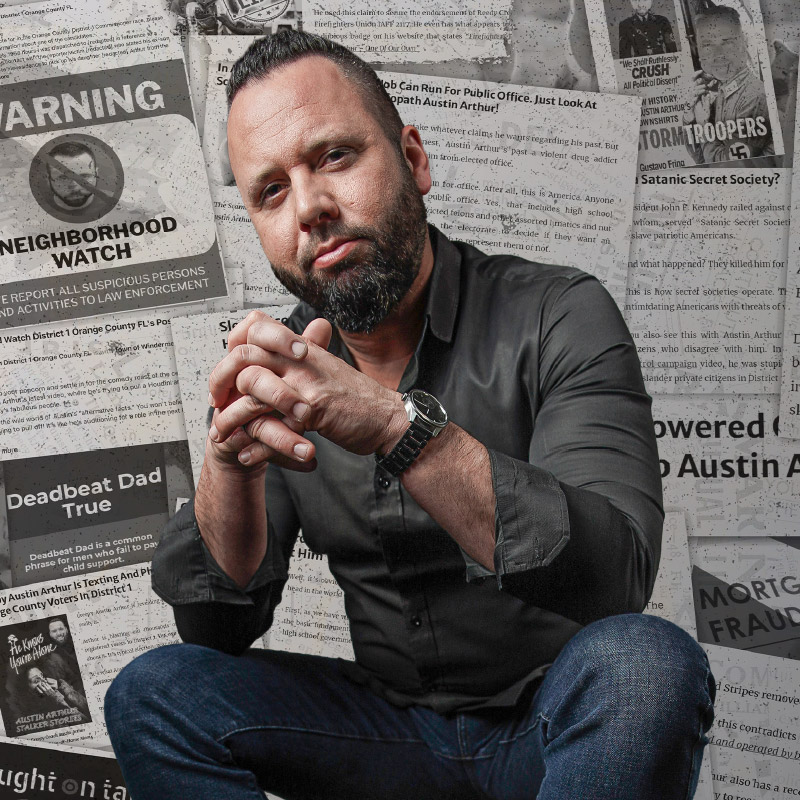
The attacks escalated with precision. A bar fight at 23 resurfaced as if it had happened last week, shorthand for moral failure. Anonymous websites went live overnight, such as, “The Real Austin Arthur.” Fake profiles appeared in comment threads. 1-800-Rent Black Kids circulated online to malign his work in East Winter Garden, insinuating that relationships built over years were transactional and staged.
A black G-Wagon drove through town with his nearly 15-year-old mugshot plastered on the side, a red X slashed across his face. Campaign signs were run over, spray-painted, scrawled with sexual vulgarities. Doctored images placed him in a Nazi uniform. A fabricated video accused him of installing secret bathroom cameras at a gymnastics center—an allegation so absurd it might have been laughable, if doubt didn’t travel faster than truth.
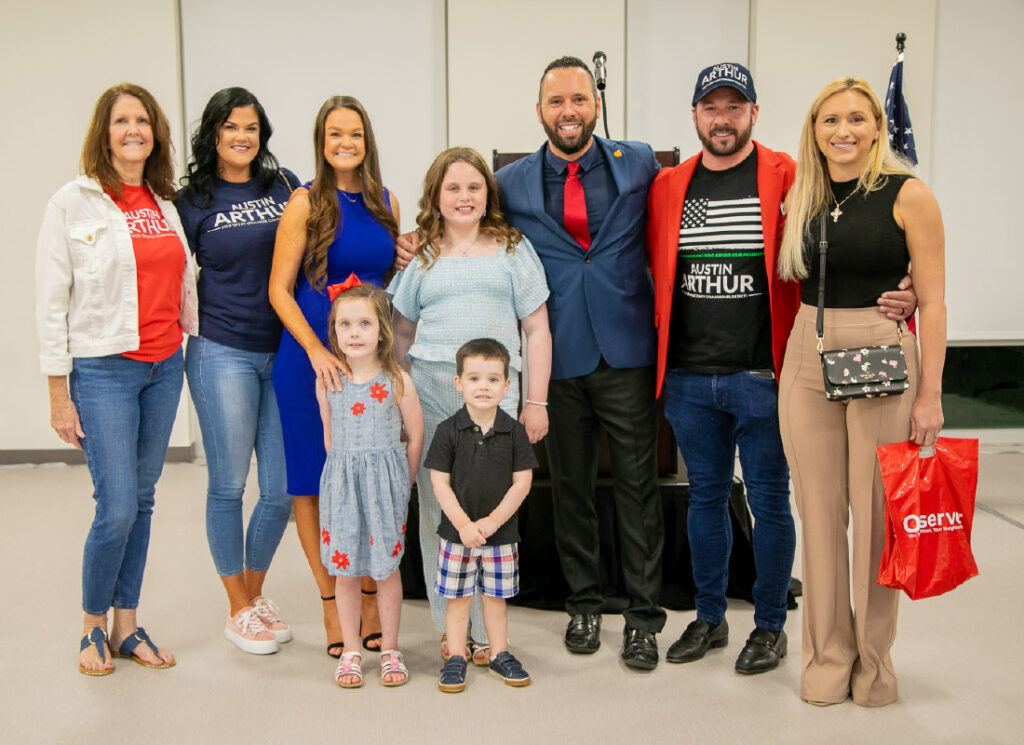
He had believed transparency would shield him. He made a video explaining his arrest before anyone else could weaponize it. He thought owning his past would defang it.
It didn’t.
“In the beginning, it hurt tremendously. It brought me to tears some nights, actually while alone or with my wife, Kellie,” he admits. “I was sick over it. When an outrageous comment went up online, I reached out to that person, invited them to call me or meet for a conversation. No one ever took me up on it. The attacks just kept coming, and coming, and coming. It was relentless.”
This is the part people don’t imagine about polarizing figures—that they go home. That they sit at kitchen tables with their wives and try to explain to their children why strangers are inventing things about them. That redemption is applauded in theory but punished in practice.
Kellie watched him absorb it. He never fired back in kind. He refused to meet vitriol with vitriol, even when it would have been easier, even when it might have been politically expedient.
The noise didn’t stop. The headlines didn’t soften. The weeks ticked by.
November came without thunder. Just numbers. He lost.
“Was I disappointed? Absolutely. But the hardest part,” he says, his voice thinning, “was seeing my daughter, Chrissy, cry after.”
Not because of ambition. Not because of ego. But because effort, in a child’s mind, should guarantee outcome. Because when you tell your daughter that hard work matters, you want the world to cooperate.
It was a father’s heartbreak, not a candidate’s.
The Cost at Home
“I sacrificed for the campaign,” he says. Then, after a beat: “That’s just true.”
It wasn’t symbolic sacrifice. It was measurable. Dinners missed. Bedtimes forfeited. Conversations postponed until they expired.
For two years, the phone did not stop. It buzzed at red lights. It lit up the nightstand at 11:47 p.m. It vibrated through church services and family dinners and the thin, fragile quiet after a hard day. Someone always needed something. A meeting. A favor. A connection. A check. Another check. Fundraising that felt less like asking and more like oxygen.
His reflex was yes.
“Yes, I can be there.”
“Yes, I’ll make the call.”
“Yes, I’ll fix it.”
“It’s kind of like an addiction,” he admits, half-smiling, though there isn’t much humor in it. “Saying no feels like failure.”
Not failure to win. Failure to show up.
Not to power. Not to attention. To being needed and making a difference.
And the dangerous illusion that saying no means letting everything collapse.
Kellie learned to read the pressure the way you read humidity before a storm. The clipped tone. The tight jaw. The way disappointment settled into his shoulders after another anonymous post or attack mailer. She kept the house steady—homework signed, dinner made, laundry folded—while the campaign roared outside the walls.
She stayed strong in front of the kids.
The tears came later. On a treadmill at the gym, running hard enough that no one would ask questions.
“I didn’t want him or the kids to see me fall apart,” she says. “So I didn’t.”
Public service sounds noble. It does not advertise the domestic collateral.
Austin knows now what he didn’t fully grasp when he started: He chose this campaign. His wife and children did not.
For years, their marriage lived along the edges of his calendar—late-night events, shared smiles across banquet tables, conversations interrupted by handshakes. He doesn’t defend it.
“I gave her… I gave them… less than I should have,” he says.
No spin. Just arithmetic.
After the election, he began doing something almost embarrassingly ordinary: He scheduled her.
Thursday lunch, blocked off like a board meeting. A monthly parents’ night out. Babysitting swaps with family. Time in ink that cannot be bumped by a donor or a committee.
The first time Kellie saw the lunch appointment pop up, she texted him: Is this real?
It is.
His days still start long before dawn Meetings stack like Tetris blocks. Board seats. Committees. Business obligations. The phone still rings. He still says yes more than he should.
But he is trying to learn the difference between being needed and being indispensable.
There is a subtle arrogance in believing the world cannot move without you. There is a quiet wisdom in realizing your family should never have to feel that way.
And that lesson hit hardest with the children. They experienced the campaign in ways he could not shield them from. The younger ones mostly remember the novelty—extra events, more people around, the feeling that Dad was important.
“In the beginning, it hurt tremendously. It brought me to tears some nights… I was sick over it.…The attacks just kept coming, and coming, and coming. It was relentless.”
Chrissy, 10 at the time, saw more. She liked walking neighborhoods with her dad, ponytail swinging, campaign flyers tucked under her arm. She liked seeing doors open. She liked watching people smile at her dad.
But she also saw the other doors. The ones that barely cracked. The tight smiles. The polite but firm, “We’re not interested.” The occasional, sharper: “You need to leave.”
And, of course, there were the whispers at school. Because tweens and teens can be cruel.
“The hardest part wasn’t losing,” Austin says. “It was watching my family carry it.”
Public debate is abstract until it lands in your child’s chest.
For all the spectacle—the caricatures, the red X through his face online, the flattening of a person into a symbol—the truest measure of cost was not measured in votes. It was measured in composure held too long. In questions that shouldn’t belong to children. In a wife saving her breaking point for a treadmill.
Sundays are non-negotiable now. Church. Lunch. Cards in the backyard. Extended family drifting in and out. No campaign talk. No comment sections. Just ordinary life—the kind that does not trend and does not require defending.
It’s protecting dinner the way he once protected a fundraiser. Guarding Thursday lunch the way he guarded a debate date. Understanding that conviction is easier than balance, and that leadership inside a house may matter more than leadership on a dais.
He hasn’t mastered that. He knows he hasn’t.
But the effort—awkward, deliberate, written in black ink on a calendar—might be the most honest thing about him.
Because saving a community does not count for much if you forget to safeguard the ones who share your last name.
Forward, Slowly
At 4:30 a.m., the house is still wrapped in night.
Austin pulls on gym clothes in the dark and slips out to meet his brother, Zander. They lift. They sweat. They move weight and breath and whatever frustration the week has handed over. No headlines. Just iron and muscle and the comfort of someone who has known you long enough not to need explanations.
By the time he gets home, the sky is thinking about morning.
Shower. Coffee. The house begins its daily crescendo—footsteps, cabinet doors, someone calling for a shoe that was definitely right here yesterday. He leans against the counter with Kellie for a minute that’s never long enough. They trade logistics and tired smiles like seasoned co-pilots. Then its hugs, backpacks, carlines, the beautiful chaos of a life that does not care one bit about polling data.
This is the part no one claps for.
Soon the day blurs into meetings, calls, community conversations, problems that need solving and people who just want to be heard. The possibility of another campaign hums in the background like a generator, steady, waiting.
He knows what it will cost now.
He also knows what it gave him.
After the accusations, the lies, the nights he lay awake wondering if he’d let people down, he keeps circling back to the same simple truth: He cares about people.
Not in the polished, podium-ready way.
In the messy, show-up-anyway way.
Maybe that’s the real story.
Not the loss in August.
Not even the runoff in November.
But a man learning, in real time, how to hold ambition in one hand and humility in the other…
how to step into public life without completely stepping out of his own…
how to take the hits without letting them harden him.




3 Responses
Wonderful article, thank you for your dedication we should never feel bad about trying to make a difference.
Stay true to who you are faith and family
All the talk about boards he’s on and you neglect to mention (like a journalist should) that Austin sits on the advisory board for this publication. Weird omission.
The Local is a lifestyle magazine—not intended to be read as news. We are community focused and strive to celebrate the people that make up our little corner of the world. That said, I recognize that the story we sought to tell about Austin—while intended as a human interest piece—can also be viewed through a political lens. So it is a fair criticism that we should have noted it in the story. We will be more mindful of this moving forward. Thank you for your comment and thank you for reading!